



Mission & History
Musée de CloudWei was founded and created by the Canadian artist-curator CloudWei C in spring 2025. It is a non-profit platform that focuses on conserving, researching and communicating about art.
CloudWei started to collect Hermès scarves on a trip to Paris, France, in the late 2000s. She was looking for a luxurious and artistic present for her dear aunt. After exploring the beautiful Hermès boutique in Paris. She found a scarf for her aunt and several pieces for herself, which exceeded her expectations. Her companions thought the scarf would age young ladies. However, she was attracted by the heritage and craftsmanship of Hermès. She believed the artistic value of Hermès turns its scarves into wearable art pieces. Until now, it has not changed.
CloudWei is genuinely passionate about art, especially the Hermès art. She has been voluntarily publishing articles about the Hemès scarves since 2012 on the largest Chinese forum in North America, and various social media in North America and Asia. She has also been virtually offering information and coordinating threads on the forum about Hermès scarves. Millions of viewers have benefited from the information, knowledge, personal views and suggestions that she shared.
Cloud Wei loves the subject of the arts and humanities. She has worked and volunteered in several museums and art galleries in North America, Europe and Asia. She has been learning and doing research about the indigenous peoples’ cultures in North America for years, and has completed The First Nations and Indigenous Studies at the University of British Columbia and The Indigenous Canada course at the University of Alberta in 2019.
Among the indigenous theme scarves that CloudWei curated, the iconic Kachina tells the story of the Hopi people. It was designed by Mr. Kermit Oliver, first issued in 1992 and has been reissued several times over the decades. CloudWei shared all the Kachinas’ Identities (a total of 25 dolls) on the scarf with details on her Instagram account on 8th – 10th January 2020. Many people showed their great interest in those posts and expressed their appreciation and encouragement to Cloudwei.
It turns out that many people are also interested in the in-depth details of the Hermès scarves.
With the support of Hermès society friends and followers, CloudWei created her first blog, “Le Jardin de Cloud”, in February 2021. The content of the blog was all about the Hermès scarf. She works behind the scenes to progress the way to view, understand and appreciate the Hermès scarf. In there, she shared her private collection with in-depth study research, Hermès annual theme and design story, history, national culture, religions and spiritual traditions, mythology, geography, biology, art and humanity, artists’ design ideas and inspiration, styling and silk care practical tips and solutions, and handcrafted jewellery. One of her remarkable achievements was that she published an in-depth article about Kachinas with eight chapters in March 2021.
During 2021 to 2022, she published over 90 Hermès scarf articles in her blog “Le Jardin de Cloud”. The in-depth research articles comprise Kachina (Kermit Oliver, 2019), Into the Canadian Wild (Alice Shirley, 2017), La Maison des Carrés (Pierre Marie, 2015), Faubourg Tropical (Octave Marsal and Théo de Gueltzl, 2021), Objets de Curiosité (Rosa Maria Unda Souki, 2022), Eleftheria (Elias Kafouros, 2021), Au Coeur de la Vie (Aline Honoré, 2014), Cent Plis des Miao (Aline Honoré, 2010), La Femme aux Semelles de Vent (Aline Honoré, 2009), Turandot (Natsuno Hidaka, 2002), Duo Cosmique (Kohei Kyomori, 2021), Masan & Masan (Terawat Teankaprasith, 2021), Ex-Libris en Kimonos (Anamorphée, 2011), La Légende du Cheval a Plumes (Ugo Gattoni, 2020), Ex-libris Atlantis (Ugo Gattoni, 2021), Les Ailes de Pégase (Camille Pozzo Di Borgo, 2022), Acinonyx Jubatus(Robert Dallet, 2021), Halte en Camargue (Robert Dallet, 1988), Flamingo Party (Toutsy, Laurence Bourthoumieux, 2015), Space Derby (Ugo Bienvenu, 2021), Le Jardin de Leïla au Bloc (Françoise Houtin, 2019), Jardin à Sintra (Annie Faivre, 2014), Jardin d’Hiver (Annie Faivre, 2015), etc.
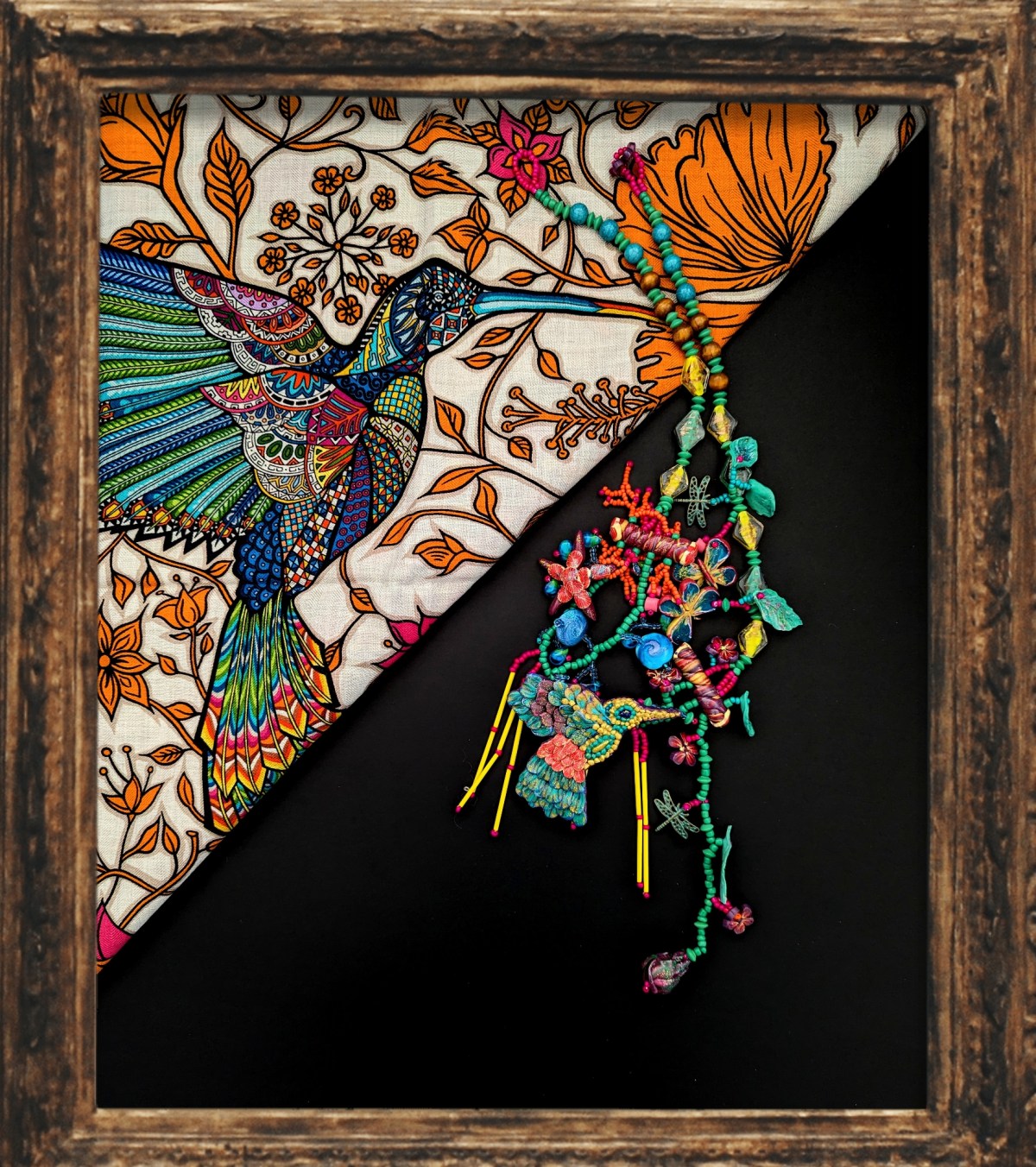
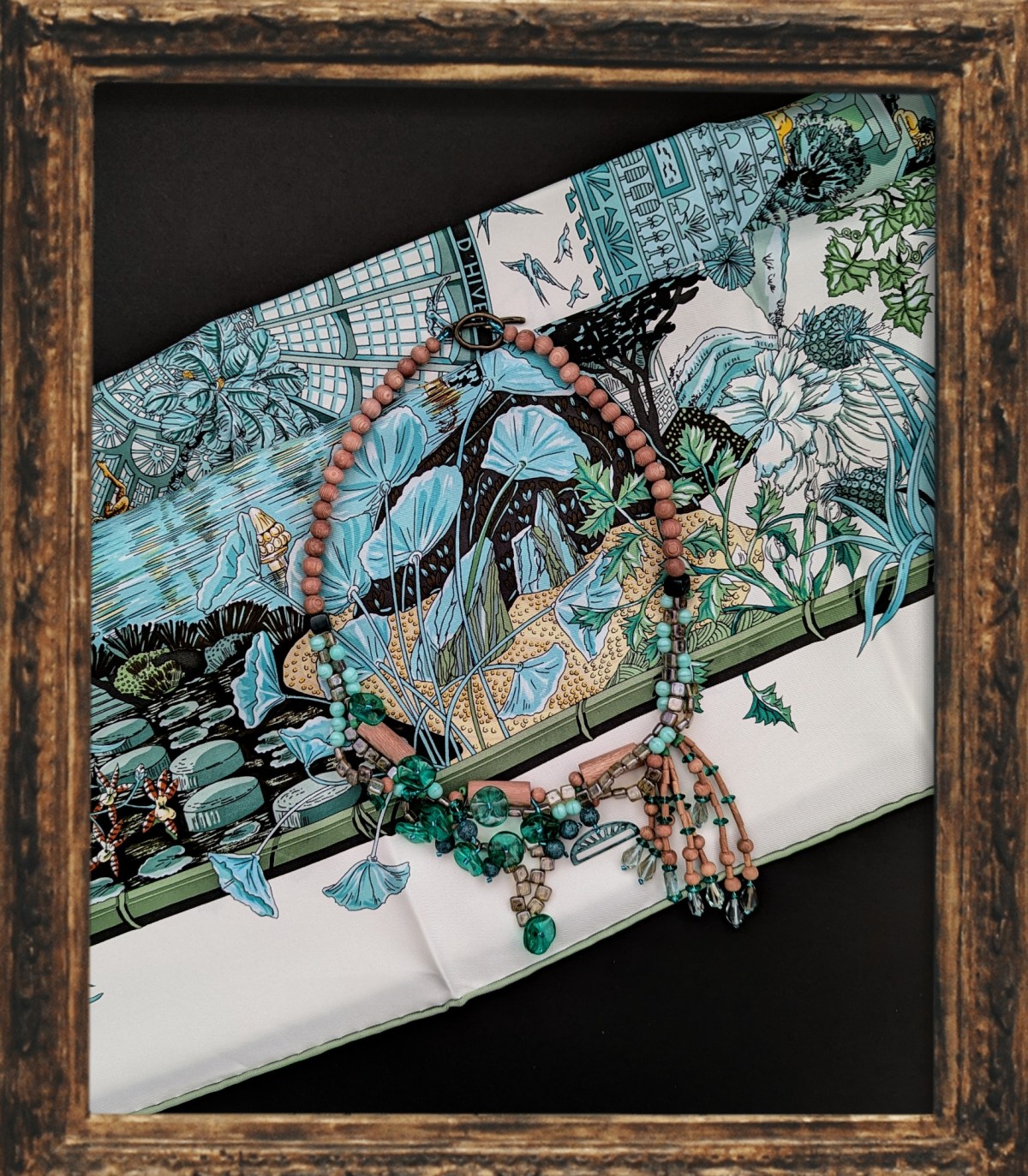
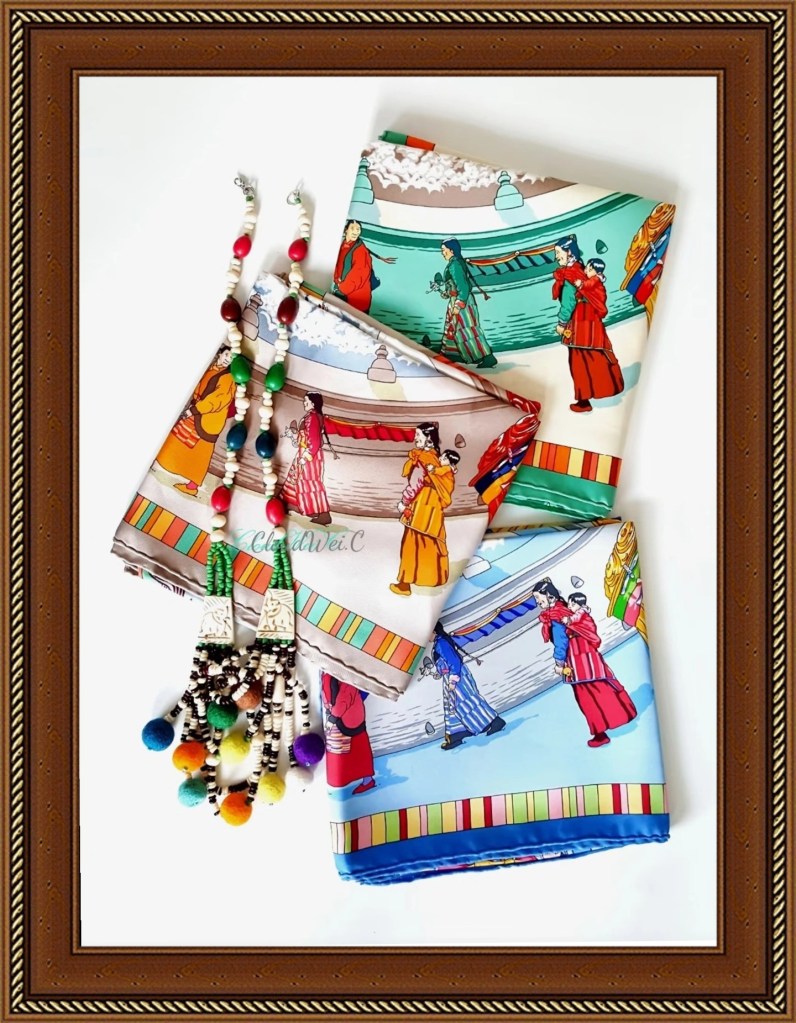
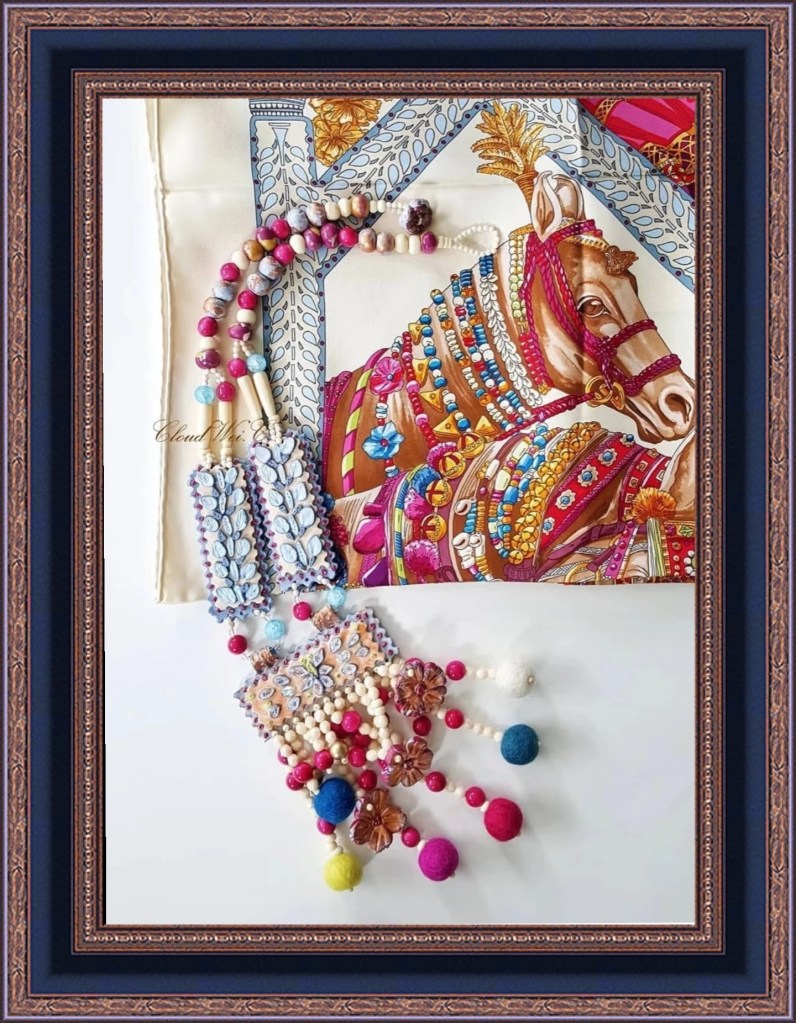
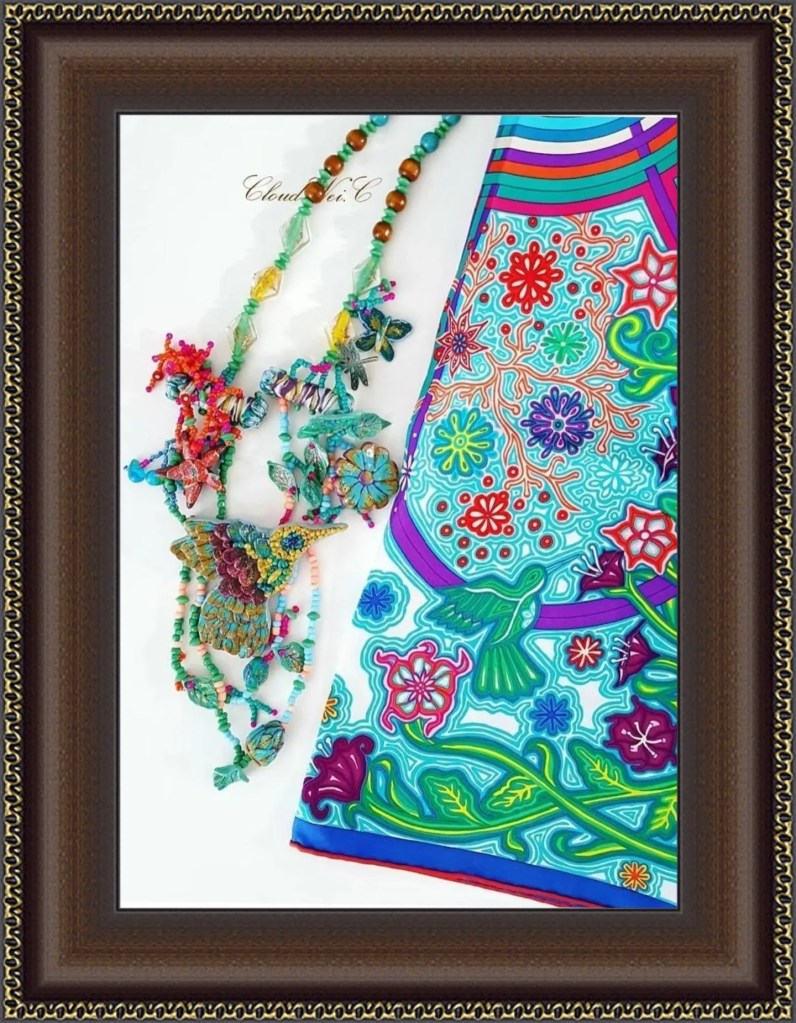
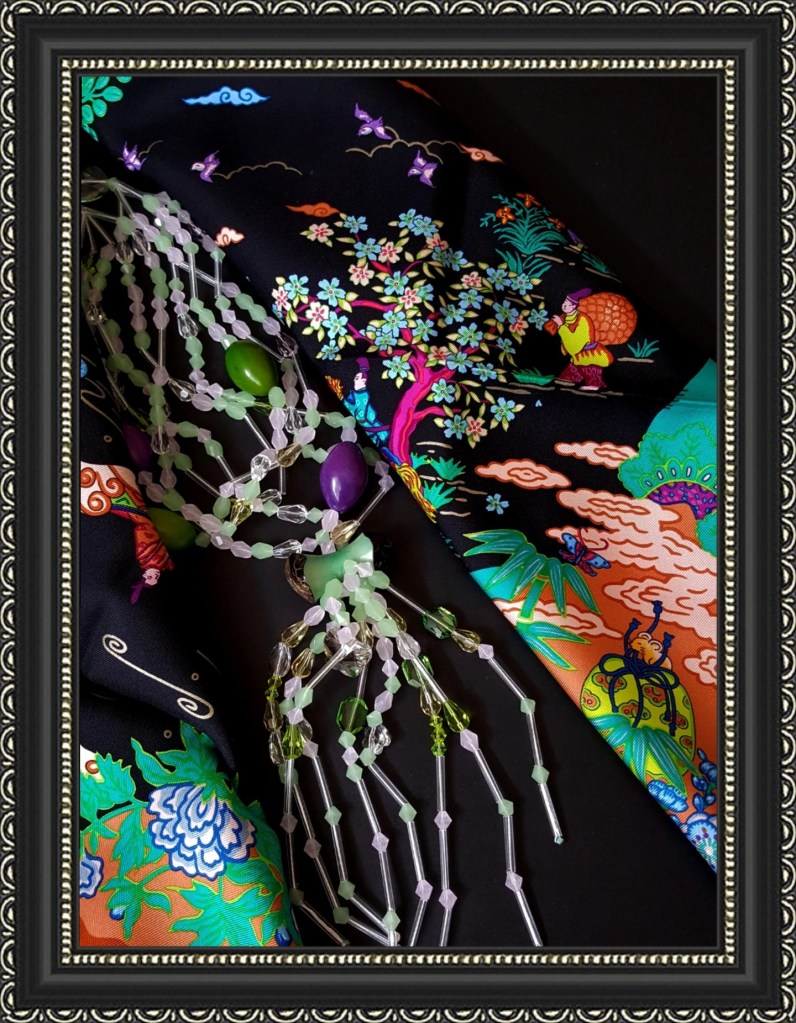
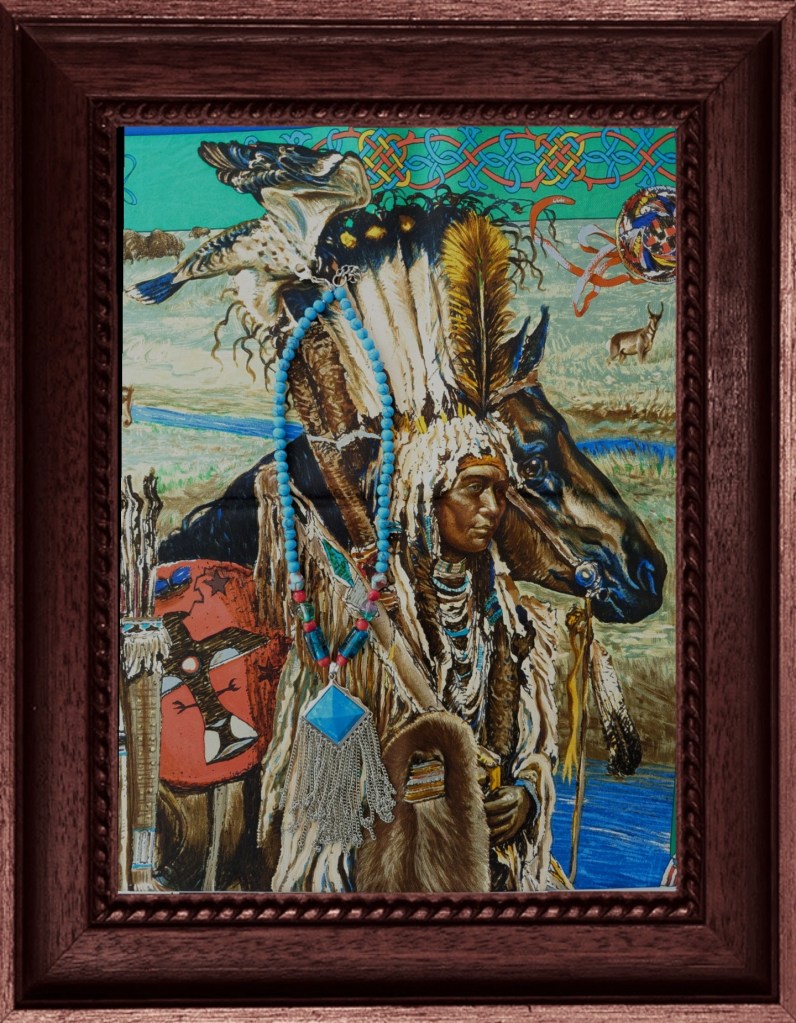
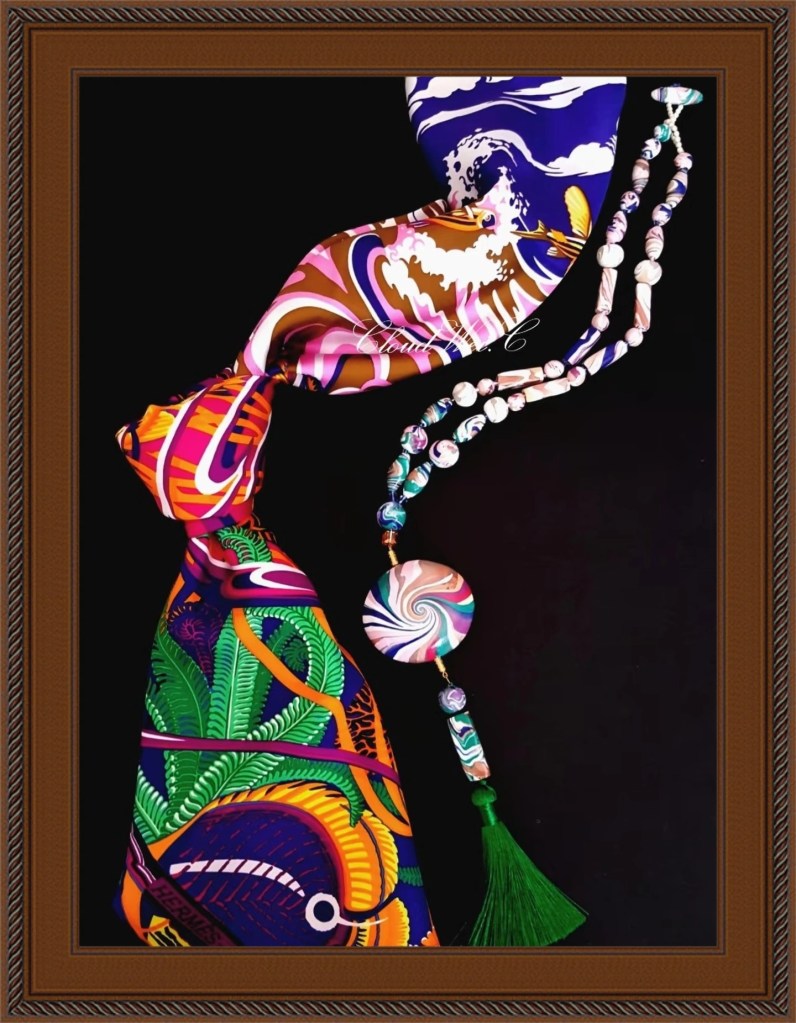
Not only does CloudWei work as a bridge between art and language, but she also transforms the art into jewellery from her perspective. As an artist, she would pay attention to the details and create one-of-a-kind jewellery specifically to match her scarf collection. She supports fair-trade organisations, women’s living organisations, rainforest conservation and indigenous communities, etc. In most of her projects, she uses eco-friendly & recycled materials. To match the details on the scarves, sometimes she would create the specific elements for the jewellery, even tiny beads.
The pieces of jewellery that she designed for her Hermès collection include L’Arbre du Vent (Montserrat Gonzalez-Lugo, 2015), Le Jaguar et le Colibri (Montserrat Gonzalez-Lugo, 2023), Tapis de Selle (Annie Faivre, 2020), La Femme aux Semelles de Vent (Aline Honoré, 2009), Au Coeur de la Vie (Aline Honoré, 2014), Prières au Vent (Dimitri Rybaltchenko, 1996), Noël au 24 Faubourg (Dimitri Rybaltchenko, 2004), Les Quatre Saisons (Robert Dallet, 1994), Ballade de Heian ( Natsuno Hidaka, 2009), Les Artisans d’Hermès (Akira Yamaguchi, 2020), Kachinas ( Kermit Oliver, 2019), Plumes en Fête (Aline Honoré, 2020), Dans un Jardin Anglais (Alice Shirley, 2015), Jardin d’Hiver (Annie Faivre 2015), La Danse du Cheval Marwari (Annie Faivre, 2008), Trésors Retrouvés (Annie Faivre, 2012), Cavaliers du Caucase (Annie Faivre, 2014), Maîtres de la Forêt (Annie Faivre, 2016), De la Mer Au Ciel (Laurence Bourthoumieux / Toutsy, 2014), Le Jardin de Leïla au Bloc (Françoise Houtin, 2019), Kawa Ora (Te Rangitu Netana, 2019), Into the Canadian Wild (Alice Shirley 2017), Faubourg Tropical (Octave Marsal and Théo de Gueltzl, 2021), Equateur (Robert Dallet, 1988), All’Orto Botanico di Palermo (Francois Houtin, 2024), Fantaisie Pittoresque (Françoise Houtin, 2008).
 Musee de CloudWei