
Name: Hermes scarf Jardin d’Hiver
Artist: Annie Faivre
Year of Issue: 2015
Hermes Annual Year Theme: Flâneur Forever/Strolling Forever
In the 17th to 19th centuries, the elite from many cold climates cities in Europe used to build large conservatories to house tropical and subtropical plants that would survive under improved conditions. A Winter Garden’s primary purpose was to extend the elite’s living space and create an exotic environment with tropical plants. One of the Winter Garden’s functions was protecting precious plants and citrus fruit trees in the cold season, such as the tasty yet delicate orange trees and pineapple shrubs. At that time, the Pineapple, the indigenous fruit of South America, was a significant cultural icon of luxury. The warm and humid oasis mixed with lush trees, unique flowers and exotic fruits inside the magnificent architecture became an attraction for guests and visitors. It was eventually used for various purposes, such as displaying tropical plants, holding flower shows, afternoon tea parties, evening occasions, social gatherings, and academic research.

The artist Annie Faivre designed Jardin d’Hiver (Winter Gardens) for Hermès in 2007. As described in the Hermès catalogue, which was reissued in 2015, “Annie Faivre collection invites us to walk in paradise. An evocation of Eden, this abundant composition is inspired by the tapestries named vegetable greens in vogue from the late Middle Ages. The garden’s art, which is believed born in Mesopotamia, is dedicated to man’s pleasure. This order of nature folded into his aesthetic choices. Legendary gardens thrive here as an invitation to linger. The Hanging Garden of Babylon is one of the seven wonders of the ancient world. A medieval maze in the topiary art of plant height. The gardens of the Alhambra in Granada are marvels of Islamic art. The Mughal Garden, Taj Mahal. The gardens of Villa Borghese in Rome are refreshed by multiple fountains or the Majorelle in Marrakech. Painter and collector of plants, he met at a place of shadows and light, the species of the world, discovered in his travels. Wonderful mixed!”
The artist Annie Faivre designed Jardin d’Hiver (Winter Gardens) for Hermès in 2007. As described in the Hermès catalogue, which was reissued in 2015: “Annie Faivre collection invites us to walk in paradise. An evocation of Eden, this abundant composition is inspired by the tapestries named vegetable greens in vogue from the late Middle Ages. The garden’s art, which is believed born in Mesopotamia, is dedicated to man’s pleasure. This order of nature folded into his aesthetic choices. Legendary gardens thrive here as an invitation to linger. The Hanging Garden of Babylon is one of the seven wonders of the ancient world. A medieval maze in the topiary art of plant height. The gardens of the Alhambra in Granada are marvels of Islamic art. The Mughal Garden Taj Mahal. The gardens of Villa Borghese in Rome are refreshed by multiple fountains or the Majorelle in Marrakech. Painter and collector of plants, he met at a place of shadows and light, the species of the world, discovered in his travels. Wonderful mixed!”
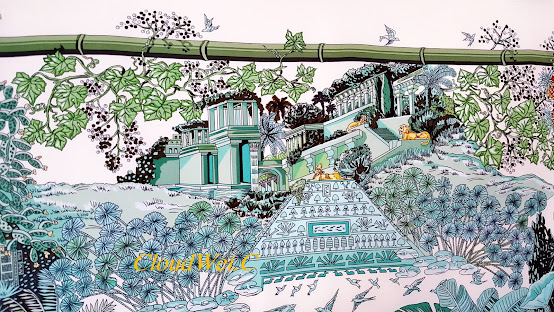
In the carré of Jardin d’Hiver (Winter Gardens), four bamboo branches frame the epitomes of some famous, extraordinary gardens collection worldwide: from a private garden property in the city centre to a hanging garden, one of the world’s ancient wonders in the air; within countries with humid oceanic climate to countries with arid desert climate; spanning across mysterious East Asia to classic Western Europe. Exotic plants, rich foliage, ripe fruits and blossom flowers dazzle the eyes, and fragrances waft through the botanical oasis dotted with artistic statues, bubbling fountains, and serene water gardens. An atmospheric river divides the carré into two overlapping realms, several existing gardens and an uncertain wonder. The following are examples that may or may not be included in Hermès’ catalogue description. The models may or may not be identical to the material objects or depictions in the scarf.
Ducks form a line in the Euphrates River; above the river is the Hanging Gardens of Babylon. It is a gift of love and one of the world’s seven ancient wonders. According to historians, Queen Amytis had difficulty adjusting to life in Babylon’s flat deserts and longed for the forests and mountains of her native Media (modern-day Kurdistan). Her husband, King Nebuchadnezzar II of Babylon, commissioned a spectacular watered paradise in the sixth century B.C. as a gift for her to cure her homesickness. Various beautiful plants, herbs and flowers filled the Hanging Gardens. The Cascades of green and purple hanging grapes are the oldest and best-known fruit plant in Iran, and their harvest took place in the garden of love.
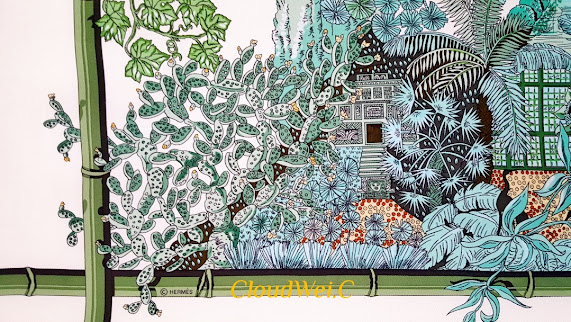
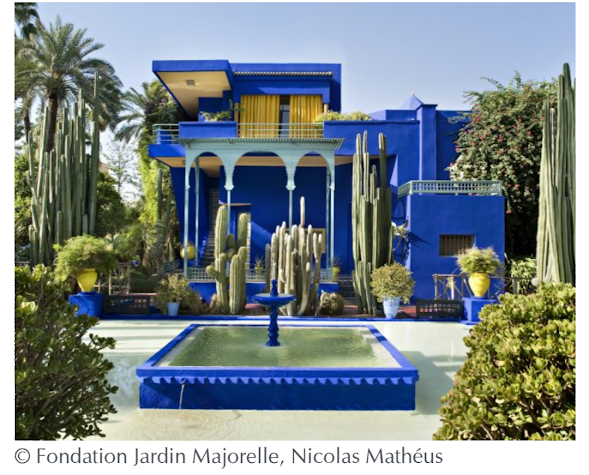
In a similar waterless desert climate to Iran, amid the arid Atlas Mountains of northwest Africa, Marrakech Morocco, is referred to as “the Daughter of the Desert”. Since 1923, the French Orientalist artist Jaques Majorelle spent over four decades building a two-and-a-half-acre botanical garden, a studio and a Moorish-style villa in Marrakech, Morocco. In the 1980s, the fashion designer Yves Saint-Laurent and his partner Pierre Bergé meticulously restored the property in the fusion of Moorish and contemporary styles. They enhanced the garden with fountains and an astonishing variety of greenery, banana trees, palms, bamboo, jasmine, water lilies, and cactus.

 Musee de CloudWei
Leave a comment