

Photo Credit to the Owner
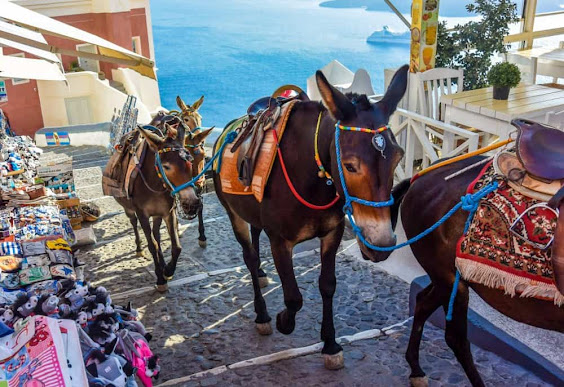
The unique geological formations and the various climates of Greece create a fertile ground where abundant wild plants could grow and a home for many wild and domestic animals such as the Kri Kri goat, mule and donkey.

The infancy of Zeus, by Jacob Jordaens, early 1630s.
Image Credit to Wiki Common.
The kri-kri goat is also known as the Cretan wild goat. In Greek mythology, the thunder god Zeus was nurtured by a goat named Amalthea. As Zeus’s father, Cronus learned from Gaia and Uranus that he was destined to be overthrown by his son, as he had previously overthrown his father. To avoid this fate, he swallowed five children as they were born. When Zeus was born, Rhea decided to keep her infant safe and gave birth to Zeus in Crete. She gave him to Ἀμάλθεια (Amaltheia) who became his foster mother. Amaltheia fed him with her milk and took care of him in a cave on Mount Ida (Crete).


Cats were sacred animals, and the goddess Bastet was often depicted in cat form in Greece. When visitors walk through the cobblestone street in Greece, they can see the cats roaming nearby, walking on a rooftop, sleeping under the sun, trotting on a balcony or stopping by outside restaurants. Most of the cats in Greece usually stay. They can survive under the mild winter in certain parts of Greece. The kind local people and tourists often take care of them with shelter, food and water.
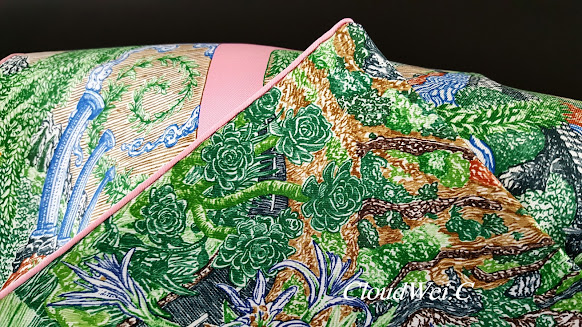
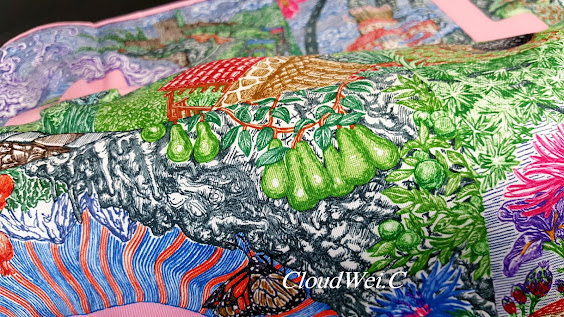
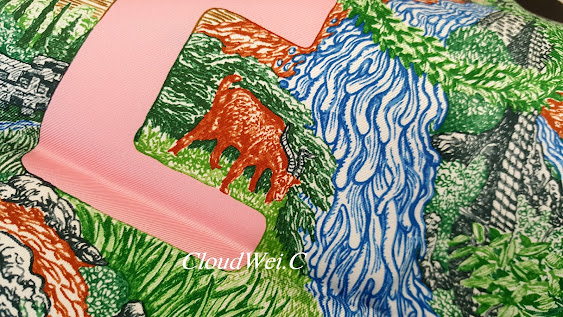
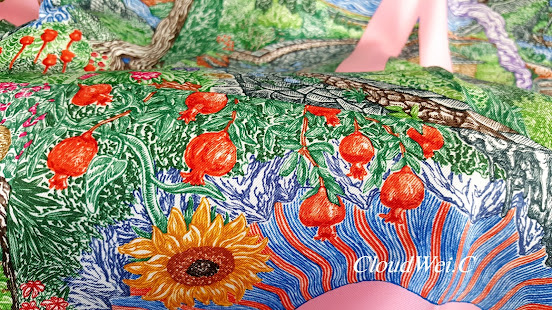
Laurel tree, sunflower, hyacinth, pear, pomegranate, goat, and other flora and fauna of Greece depicting Greek Gods’ love, hatred, passion and desire in Greek mythology are elegantly painted in the Hermès carré Eleftheria.
(In this article, mythological descriptions are according to the usual version of Greek mythology. The examples may or may not be included in the Hermès catalogue description. The models may or may not be identical to the material objects or depiction in the carré.)
All Rights Reserved.
 Musee de CloudWei
Leave a comment