
Not only does CloudWei work as a bridge between art and language, but she also transforms the art into jewellery from her perspective. As an artist, she would pay attention to the details and create one-of-a-kind jewellery specifically to match her scarf collection. She supports fair-trade organisations, women’s living organisations, rainforest conservation, indigenous communities, etc. In most of her projects, she uses eco-friendly & recycled materials. To match the details on the scarves, sometimes she would create the specific elements for the jewellery, even tiny beads.

Hermès Shawl Le Jaguar et le Colibri
Year of Issue: 2023
Artist: Montserrat Gonzalez-Lugo
Jewellery Artist: CloudWei Cheung
The Shawl design story from Hermès: “This is the story of how a strong and spirited jaguar met a delicate and joyful hummingbird. What they said to each other, no one knows. But they lived side by side in harmony for a long time. This scarf could be the precious illustration of such a tale. Montserrat Lugo depicts the two animals like jewels amid lush and vigorous vegetation whose movements echo the jaguar’s coat and the bird’s plumage. This touching scene sets the stage for contemplating dreams, the definitions of happiness, and the freedom found in choosing joy.”

Hermès Scarf Kachinas
Year of Issue: 2019
Artist: Kermit Oliver
Jewellery Artist: CloudWei Cheung
In-depth Research Article by CloudWei Cheung CLICK HERE
The Scarf design story from Hermès: “Kachinas are ceremonial dolls given to Hopi children, Pueblo Indians residing in the southwestern part of the United States. As their name implies, the Hopi live peacefully – Hopituh Shi-nu-mu means “The Peaceful People”––and in harmony with spirits. Ancestors, clouds, gods of fire or rain, and mischievous or benevolent spirits are personified in religious ceremonies involving boys from the age of six during their initiation. A link between the real and invisible worlds, these brightly coloured wooden dolls, charged with symbolism, are given to children to familiarise them with their ancestral beliefs and rituals. ”

Hermès Scarf Into The Canadian Wild
Year of Issue: 2017
Artist: Alice Shirley
Jewellery Artist: CloudWei Cheung
In-depth Research Article by CloudWei Cheung CLICK HERE
The scarf design story from Hermès: “Canada is the second biggest country in the world by geographical area. Bounded by three oceans, this vast territory is watered by thousands of lakes. Its diverse fauna is protected in a host of regional and national parks, burgeoning with wildlife. This vivid evocation by Alice Shirley presents a swirling celebration of life, an explosion of colour. A majestic snowy owl, one of the symbols of the Québec region, soars amid the aurora borealis. Animals go about their daily lives by land and sea: polar and brown bears, salmon, narwhals, orcas and whales, stags, bison, bighorn sheep, caribou, snow geese, Canada geese, butterflies and owls are depicted in their natural habitats, among rushes, at the foot of a great sequoia, in the shade of a maple tree, surrounded by blue flax flowers, in the clear waters of a river… This carré is an ode to the natural world, a celebration of its inestimable value, and a testimony to the treasures of the Canadian wild.”
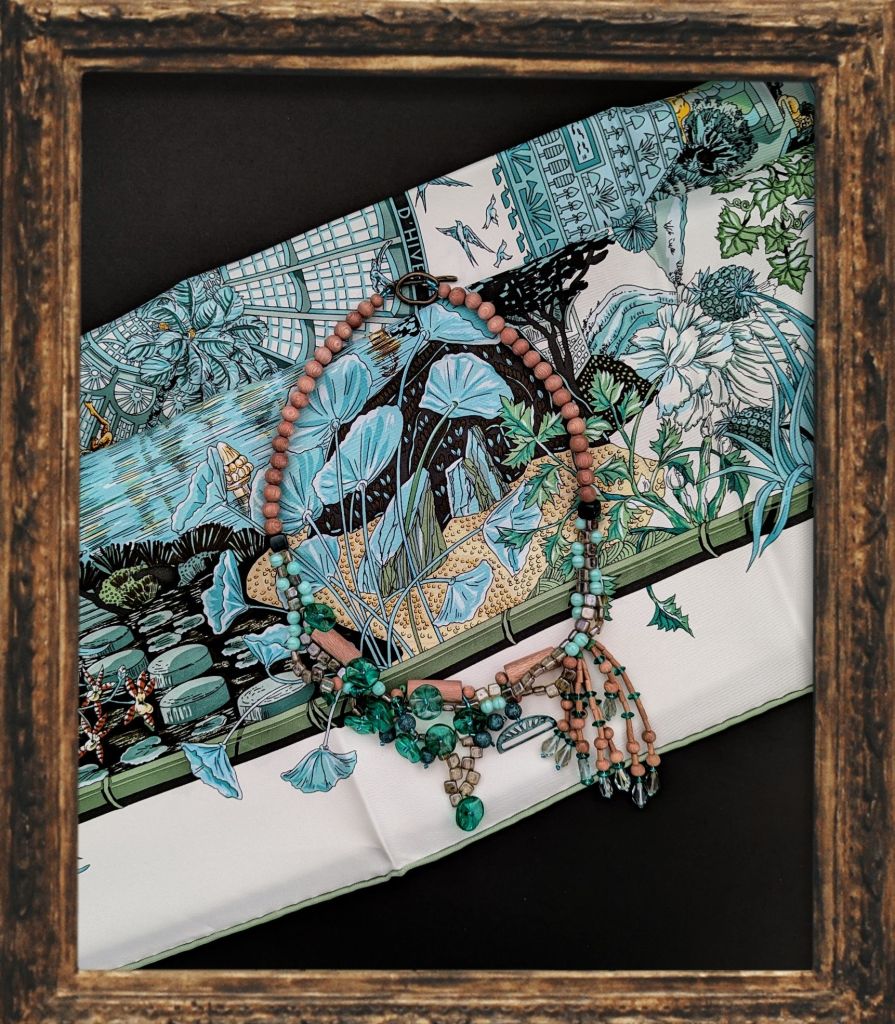
Hermès Scarf Jardin d’Hiver
Year of Issues: 2015
Artist: Annie Faivre
Jewellery Artist: CloudWei Cheung
In-depth Research Article by CloudWei Cheung
The scarf story from Hermès: “Annie Faivre collection invites us to walk in paradise. An evocation of Eden, this abundant composition is inspired by the tapestries named vegetable greens in vogue from the late Middle Ages. The garden’s art, which is believed born in Mesopotamia, is dedicated to man’s pleasure. This order of nature folded into his aesthetic choices. Legendary gardens thrive here as an invitation to linger. The Hanging Gardens of Babylon is one of the seven wonders of the ancient world. A medieval maze in topiary art of plant height. The gardens of Alhambra in Granada are marvels of Islamic art. The Mughal Garden Taj-Mahal. The gardens of Villa Borghese in Rome are refreshed by multiple fountains or the Majorelle in Marrakech. Painter, and collector of plants, it did meet at a place of shadows and light, the species of the world, discovered in his travels. Wonderful mixed!”

Hermès Scarf Plumes en Fête
Year of Issue: 2020
Artist: Aline Honoré
Jewellery Artist: CloudWei Cheung
The Scarf design story from Hermès: In a tribute to nature, its beauty and its infinite creativity, Aline Honoré draws us into a vortex, a whirling crown of feathers. Perfectly reproduced or entirely imaginary, they echo the ceremonial or celebratory adornments they can inspire. For protection, seduction or camouflage, the beauty of the feathers emanates from their function. Guinea fowl, birds-of-paradise, partridges, pheasants, manucodes, parrots… birds from all over the world lend their quill and down feathers to the artist, who magnifies and reinvents them.

Hermès Shawl Le Jaguar et le Colibri
Year of Issue: 2003
Artist: Montserrat Gonzalez-Lugo
Jewellery Artist: CloudWei Cheung
The Shawl design story from Hermès: “This is the story of how a strong and spirited jaguar met a delicate and joyful hummingbird. What they said to each other, no one knows. But they lived side by side in harmony for a long time. This scarf could be the precious illustration of such a tale. Montserrat Lugo depicts the two animals like jewels amid lush and vigorous vegetation whose movements echo the jaguar’s coat and the bird’s plumage. This touching scene sets the stage for contemplating dreams, the definitions of happiness, and the freedom found in choosing joy.”

Hermès Scarf L’Arbre du vent
Year of Issue: 2015
Artist: Montserrat Gonzalez-Lugo
Jewellery Artist: CloudWei Cheung
The Scarf design story from Hermès: L’Arbe du vent is a tribute to the Huichol people of Mexico’s western Siera Madre – also known as the Wixáritari – and their polytheistic religion, worshipping the divinity inherent in every aspect of the natural world. At its centre, the scarf depicts the eye of God, the protector, surrounded by the four elements, marking the four corners of the Huichol world: Mother Water, the origin of life, Tatei Haramara; Earth, the soul of the world, Tatei Yurianaka, with two hummingbirds fluttering above, symbolizing the souls of traditional shamans; Grandfather Fire, Tatehuari, and Air, Kieiri, the Wind Tree. Mexican artist Montserrat Gonzalez-Lugo has taken inspiration from traditional bead embroideries and threaded wool pictures to depict the essence of Huichol spirituality.

Hermès Scarf L’Arbre du vent
Year of Issue: 2015
Artist: Montserrat Gonzalez-Lugo
Jewellery Artist: CloudWei Cheung
The Scarf design story from Hermès: L’Arbe du vent is a tribute to the Huichol people of Mexico’s western Siera Madre – also known as the Wixáritari – and their polytheistic religion, worshipping the divinity inherent in every aspect of the natural world. At its centre, the scarf depicts the eye of God, the protector, surrounded by the four elements, marking the four corners of the Huichol world: Mother Water, the origin of life, Tatei Haramara; Earth, the soul of the world, Tatei Yurianaka, with two hummingbirds fluttering above, symbolizing the souls of traditional shamans; Grandfather Fire, Tatehuari, and Air, Kieiri, the Wind Tree. Mexican artist Montserrat Gonzalez-Lugo has taken inspiration from traditional bead embroideries and threaded wool pictures to depict the essence of Huichol spirituality.
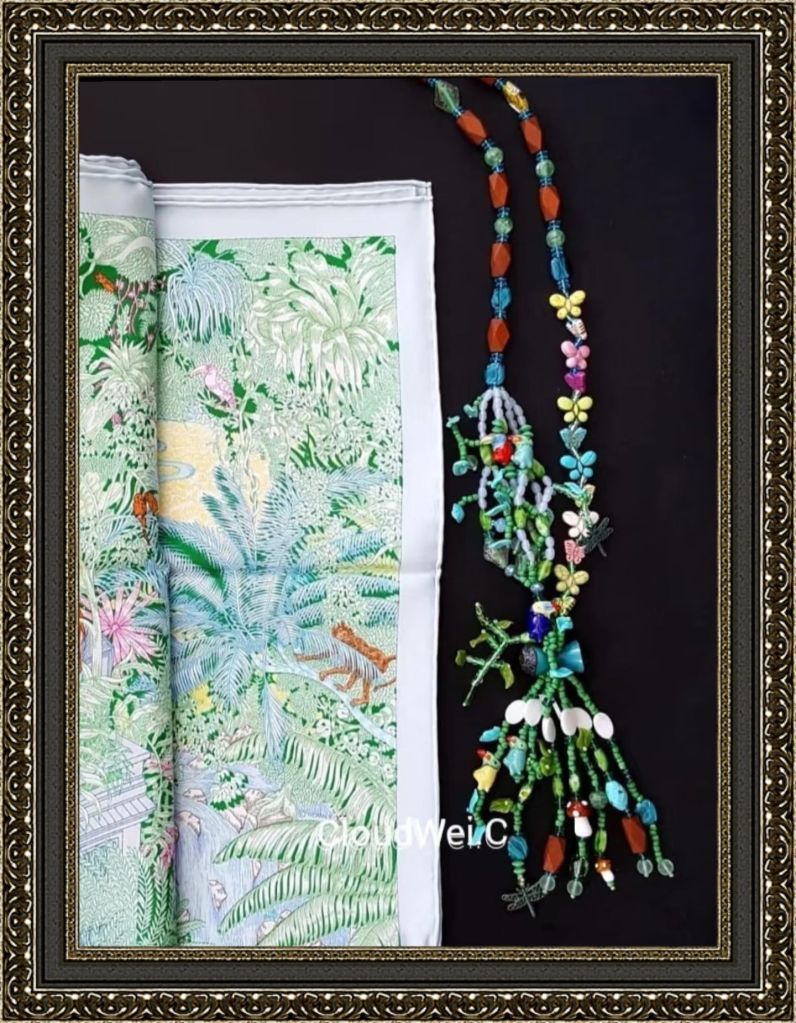
Hermès Scarf Faubourg Tropical
Year of Issues: 2021
Artist: Octave Marsal and Théo de Gueltzl
Jewellery Artist: CloudWei Cheung
In-depth Research Article by CloudWei Cheung
The Scarf design story from Hermès: “The first Hermès store opened at 24 Faubourg Saint-Honoré in Paris in 1880, in a building of modest dimensions that also housed saddlery workshops and private apartments. The current neoclassical façade is the result of audacious building work carried out between 1924 and 1926, extending upwards to create additional floors and a surprising roof terrace. It is from this terrace that the exuberant tropical forest designed by the duo of Octave Marsal and Théo de Gueltzl appears to unfurl. Cheetahs, monkeys and cockatoos blend into this botanical canopy, which also conceals the unexpected figure of the mounted cavalryman from the top of Faubourg Saint-Honoré, who has escaped to the jungle.”
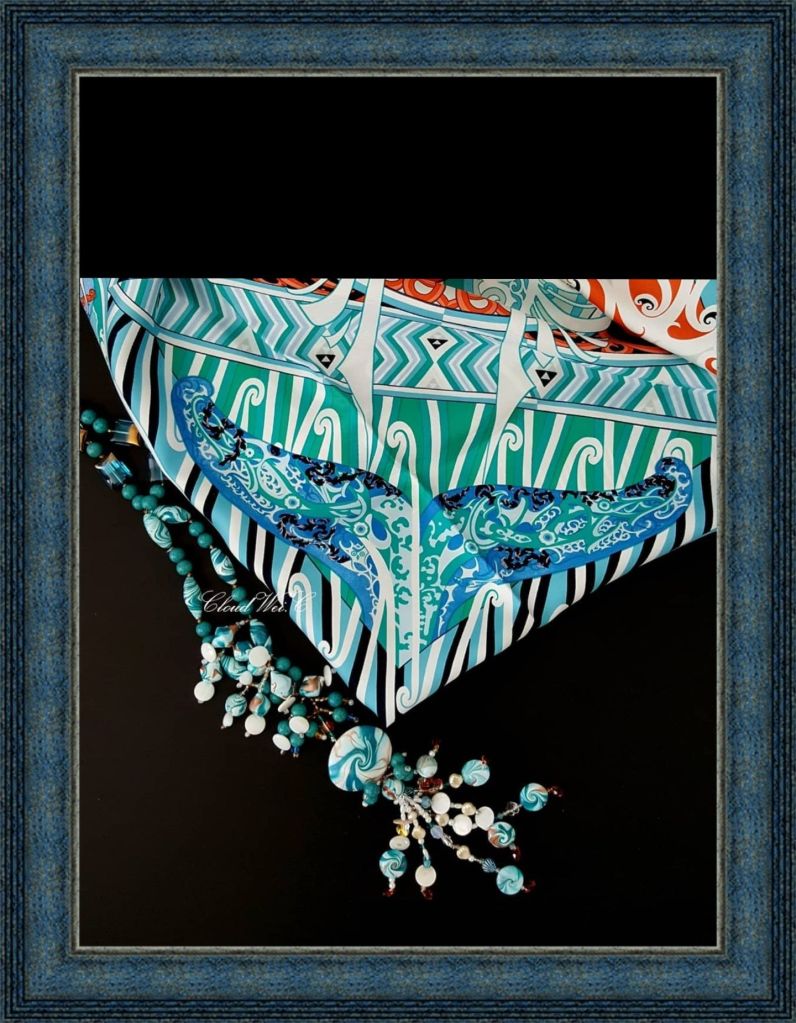
Hermès Scarf Kawa Ora
Year of Issue: 2019
Artist: Te Rangitu Netana, 2019
Jewellery Artist: CloudWei Cheung
The Scarf design story from Hermès: “Te Rangitu Netana, a Maori tattoo artist took inspiration from the life of his ancestors and Maori culture to design this scarf. An owl, the messenger between the material and spiritual worlds, rises above the four walls that draw the house of the tribe’s meeting place. Knowledge and a connection to the sky are represented on the northern wall, creation and water on the southern, light and the giant eagle on which the Maori have travelled on the eastern. The albatross tears represent the suffering of the Maori people in the western. The central circle represents a giant octopus, a symbol of navigation, and its tentacles, the eight directions of the Maori compass, in a spirited crossing of cultures.”
 Musee de CloudWei